I’m calling it. “People shop using AI now.”
Prepare to have all your outdated beliefs and assumptions about AI shopping completely smashed to bits. I’m not going to be nice about this. I’m going to rip off the band-aid. If you read on, you’re gonna lose a strip of hair. It’s going to sting like hell for a few seconds. But I plan to get your attention and you’ll thank me by the end.
AI shopping has already taken over. I don’t mean ChatGPT and Gemini and Siri and the others are driving more sales than Amazon, I mean the trendline on this is so insane, and the stats are so dramatic, it’s only a matter of time before Amazon is supplanted (when it comes to product discovery and consideration).
Here’s what I think is driving it: Research is a pain in the ass. The tyranny of choice is exhausting and makes people miserable post-purchase. AI solves this. It takes over the heavy lifting and not only that, makes consumers think they’re smart, savvy, and discerning, if only by proxy. The truth is, they’re lazy. And so am I. Honestly, If AI can find the best espresso machine using subsecond processes, why would anyone scour Best Buy, Amazon, Target, and Walmart for hours only to end up confused, frustrated, and utterly lost at sea trying to compare pricing and specs. No. F*ck that. We all have better things to do.
It doesn’t even matter what I think — the most recent stats support AI shopping as the soon-to-be “new normal” for everyone, everywhere. So let’s dispense with the usual ecommerce futurism. No five-year forecast. No history lesson about how we got here. Just… wake the f*ck up! Please? I told you this would be brutal.
AI shopping is happening now, and it is moving fast enough that the Brands and stores treating it as something to think about next quarter are going to discover, rather unpleasantly, that their competitors have already become the new darlings of the AI era while their own year-end numbers don’t look so good.
I want you to follow the data on this so there can be no wiggle room around the shift to AI commerce. And don’t think for a second things are going to go back to the way they were before… just nine months ago.
NIQ reported this week that 51% of U.S. consumers have used at least one AI-powered tool to help them shop in the past month. That is the first time adoption has crossed the halfway mark. NIQ describes it as a tipping point, with AI now influencing the way consumers discover, compare and ultimately purchase products. That’s up from 32% just nine months prior, btw. (NIQ)
Another 2026 study, from Optimove, puts the behavior even more starkly: 72% of consumers surveyed said they regularly or occasionally consult AI tools such as ChatGPT, Claude or Gemini for shopping ideas or gift recommendations. Nearly half—49%—said they do so regularly. (Optimove)
There is a tendency to look at numbers like these and file them under "AI adoption," as though they are simply another technology metric to track. That misses what is actually changing. Consumers aren't merely adding AI to the list of places where they search for products. They are handing everyday shopping over to a machine: comparing options, narrowing the field, evaluating products and deciding what deserves consideration in the first place.
The whole research layer has collapsed. That’s the key takeaway.
The “decision” is moving upstream
The traditional ecommerce journey assumes that the retailer gets a chance to make its case. A shopper searches for something, encounters a product or a brand, visits the site, reads the description, compares alternatives, checks the reviews and eventually decides whether to buy. Even when the shopper arrives through Google, an ad or a marketplace, there is still an opportunity for the retailer to influence the decision once the customer gets there.
AI moves that decision upstream.
A shopper can describe what they need to an AI assistant and ask what they should buy. They can give it a budget, explain their preferences, tell it what they don't like, ask it to compare products and then ask another question about the shortlist. By the time that shopper reaches a retailer's website, the retailer is dealing with a customer whose consideration set has been constructed somewhere else.
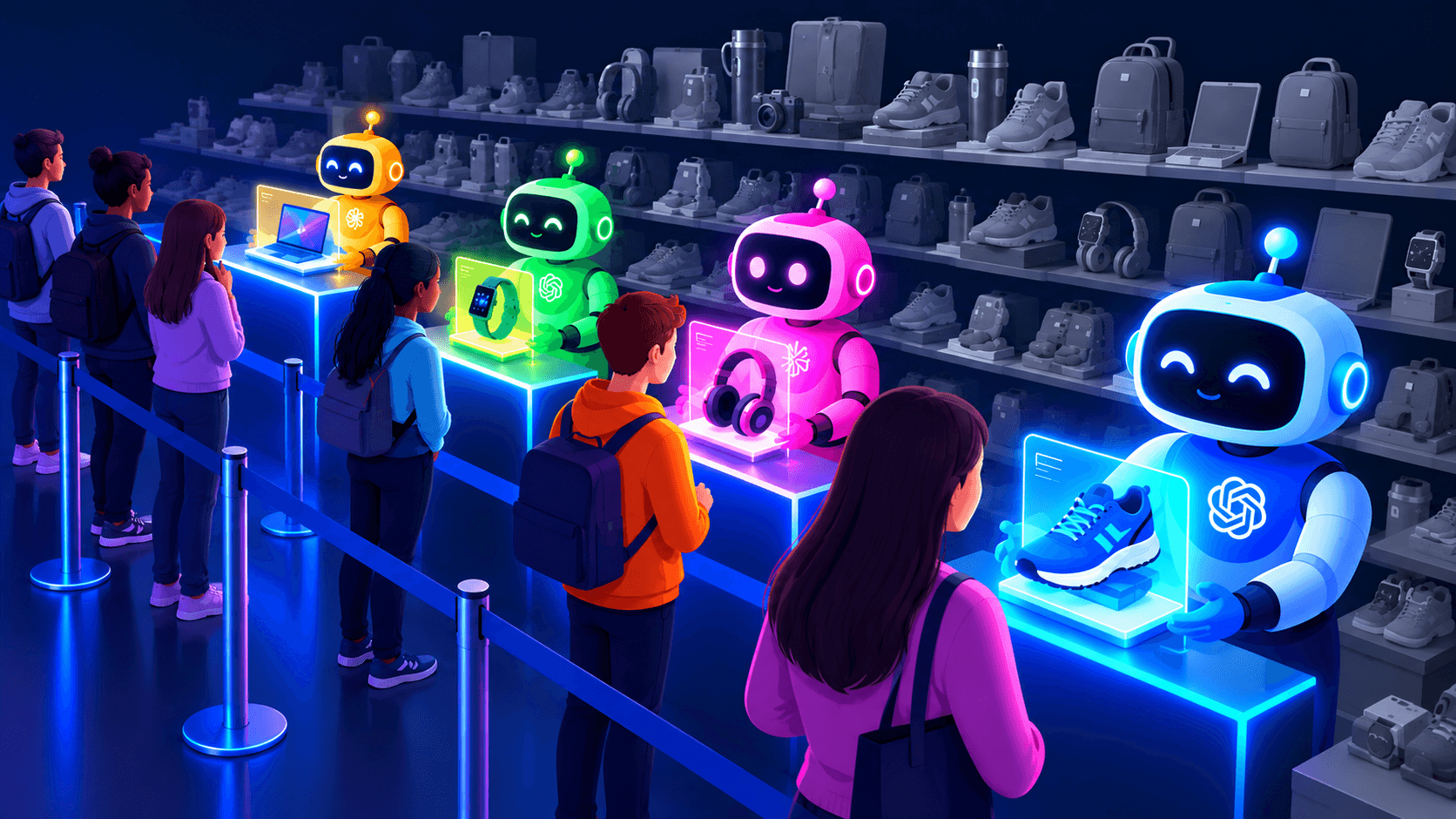
AI is the gatekeeper. AI bots and agents decide which products ever see daylight. AI narrows your choices down to one or two options. Then, you choose where to buy, if not directly in-app.
I’ll go further. AI is one step away from making the buying decision autonomously. Watch out for that one. It’s coming soon to an AI near you. But for now, the user is still pulling the trigger. But wait… there’s something unprecedented about exactly what users will pull the trigger on.. Stay with me.
Razorfish's 2026 research with GWI found that 94% of U.S. AI users would consider a brand beyond the one they normally buy if an AI assistant recommended it. Fifty-seven percent of AI shoppers said they had actually purchased from a brand they weren't considering when they started shopping. (Razorfish)
Think about what that means for a brand that has spent years trying to get onto the customer's radar. AI doesn't necessarily care whether the shopper has heard of you before. If your product is relevant to the question, you can enter the consideration set at the moment the customer asks what to buy.
The inverse is equally important. A retailer can have an established brand, award-winning website, and a substantial advertising budget and still fail to appear when the customer asks AI the question. The customer doesn't think about the brands they don’t see. They just buy the product that was recommended.
I love this new customer journey, actually, because the playing field has been leveled — at least for those that take action (more on that later). It’s simple: give the AI bots and agents what they want and you can win the recommendation. I wrote about how to do that here.
The recommendation is becoming a new kind of shelf space
This is where some of the assumptions that have governed ecommerce for years start to look increasingly dated.
Retailers have traditionally fought for shelf space, search position, advertising placement, homepage real estate and brand recognition. AI creates another form of shelf space, except the shelf is generated dynamically around the customer's question.
There’s no number-one ranking position. There’s not even a conventional ranking. AI agents work differently: they determine which products make sense for a particular shopper, under particular circumstances, at a particular moment in time.
That creates an extraordinary opening for unfamiliar brands.
It should also light a fire under the asses of the Brands and stores that assume being “established” automatically makes them visible.
Optimove found that 44% of consumers trust AI-generated product recommendations more than recommendations from other sources, while another 31% trust them about the same. In that study, three-quarters of respondents therefore placed at least as much trust in AI recommendations as they did in other recommendation sources. (Optimove)
That doesn't mean brand loyalty has vanished. It means something more subtle—and potentially more consequential—is happening. The recommendation itself is acquiring authority… and fast.
Consumers may still have favorite brands. They may still walk into a store knowing exactly what they want. But increasingly, there is another path: I need this. What should I buy? ChatGPT, find me the best… And just like that, brand doesn’t matter anymore.
It’s a very different battleground than it was in 2025.
The money is already following the behavior
Non-believers will dismiss everything I have said so far and chalk AI shoppers up as a novelty. They’ll say AI-generated shopping recommendations produce curious visitors with one thumb on the back button. Emerging commercial data suggests otherwise. I’m not going to soft-peddle it: AI shoppers convert better and they spend more. Period.
Adobe reported that AI-referred traffic to U.S. retail sites converted 60% higher than non-AI traffic in July 2026. AI-referred visitors also showed stronger engagement: they spent 59% more time on site, were 33% less likely to bounce and added products to their carts at a 28% higher rate. Adobe also reported that AI traffic to U.S. retail sites was up 62% year over year in July and had increased 1,219% since October 2024. (Adobe Business)
Those numbers matter because they tell us something about the quality of the traffic, not merely its volume.
An AI-referred shopper can arrive after the AI agent has already helped them figure out what they want. Some of the comparison work has already happened. Most of the uncertainty has already been removed. The shopper has a much clearer idea of the product, the price and the alternatives than someone who simply clicked a conventional search result. Apparently high-confidence shoppers open up the wallet a little wider too — AI-referred orders on Shopify had a 14% higher average order value than orders from organic search. (Shopify)
So AI isn't sending stores a mixed bag of users to sift through like the old days.
It’s sending people who already know what they want with high intent to buy.
AI is a fundamentally different acquisition channel.
And then we get to the part that should concern all brands and stores
The adoption numbers would be interesting enough on their own. The conversion data makes them commercially relevant. But the most revealing numbers may be the ones showing how many retailers aren't visible in the AI recommendation layer at all. The term “ghost store” was coined for those poor souls.
A 2026 CiteVantage study of 181 U.S. ecommerce brands found that 87% were invisible to the AI systems it tested when asked purchase-intent questions in their respective categories. Recomaze, in a much larger study involving 9,720 ecommerce stores and 58,320 AI recommendation tests, found that 60% of the stores were recommended zero times across the six purchase-intent queries it tested.
That is not a ranking problem in the conventional sense.
It is an existential problem.
A retailer can have a fully functioning Shopify or WooCommerce store, thousands of products, years of SEO work, a recognizable brand and a perfectly competent marketing department—and still not make it into the answer when a customer asks an AI what to buy. In other words… See ya!
That is a particularly nasty problem because most brands and stores have no idea they are getting ghosted. They don’t even have reports set up in Google Analytics or Clarity to properly track AI visitors.
It’s actually worse than that. There is no lost impression report saying, Your competitor was recommended instead of you. There is no abandoned cart. There is no customer survey asking why they never visited. From the merchant's perspective, nothing happened. Just the sound of crickets chirping.
From the customer's perspective, everything happened.
They asked a question. The AI gave them an answer. They considered the products they were shown and made their purchase decision in record time.
The ghost store simply wasn't part of the conversation.
This is not another SEO checklist
The natural reaction is to treat AI commerce as a new flavor of search optimization. Update the product descriptions. Add some structured data. Put "AI" into the marketing plan and call it a day.
That would be a mistake.
AI systems need to understand products, not merely find webpages containing product-related words. They need accurate information about what a product is, what it does, what options are available, what it costs and whether it is actually available. Increasingly, the systems need access to reviews and other signals that help them determine whether a recommendation is useful, credible, and authenticated.
And when the shopping journey becomes agentic—when AI isn't merely recommending a product but helping facilitate the transaction—the requirements become more demanding still.
This is why the technical side of AI commerce matters so much. A product catalog designed primarily for a human browsing a webpage is not necessarily a product catalog designed for an AI system trying to interpret thousands of products and decide which one best answers a shopper's question. It’s an important distinction that can easily flummox merchants, in-house IT teams, devs, and agencies.
The strange thing about this market is that it is still wide open
There is another piece of the data I need you to pay attention to, because I won’t allow you to assume that AI shopping will simply reproduce the existing ecommerce hierarchy after the dust settles in 6 months.
In Recomaze's study, 50,287 different brands were recommended across 58,320 AI tests. The 100 most-recommended brands accounted for only 11% of all recommendations.
That doesn't mean the big retailers and mega marketplaces suddenly don't matter. They obviously do.
It does suggest, however, that the AI recommendation shelf is not yet completely occupied by the same handful of companies that dominate traditional ecommerce. There is still considerable fragmentation, which means there is still room for brands to establish themselves in this new layer of product discovery.
That window will not remain equally open forever.
As AI shopping becomes more common, more merchants will optimize their catalogs, feeds, code, product information and infrastructure for it. More brands will figure out how to become legible to the systems making these recommendations. More retailers will compete for the same recommendation opportunities.
But right now, a staggering number of merchants aren't even in the game.
Which brings us back to the 51%.
More than half of U.S. consumers are already using AI to help them shop. Seventy-two percent of consumers in another study are consulting AI for shopping ideas and recommendations. Consumers are willing to consider unfamiliar brands when AI recommends them. AI-referred retail traffic is growing rapidly and converting at materially higher rates than non-AI traffic.
And yet a large proportion of ecommerce stores are apparently nowhere in the recommendation. They’re invisible ghost stores. Sucks to be them.
That is not a distant possibility. It is a market forming in real time.
AI shopping is not coming for ecommerce. It is becoming ecommerce.
There is a temptation, whenever a new technology appears, to wait for the dust to settle. Let the early adopters figure it out. See which platforms win. Watch what Google does. Wait for Shopify to make a move. Revisit the issue when the technology is more mature.
That strategy makes a certain amount of sense when the technology is experimental.
It makes zero sense when half the nation's customers are already using it.
Factor in also that AI commerce standards like ACP and UCP were just developed by OpenAI and a cabal made up of Google, Shopify, Etsy, Wayfair, Target, and WalMart. Does anyone think they’re playing for fun?
The uncomfortable truth for ecommerce operators is that the shopping journey is changing whether they participate or not. Consumers are moving toward AI for discovery and recommendation at a breakneck pace. The decision is moving upstream. The recommendation is now a meaningful source of authority. The economic value of AI-referred shoppers is showing up in the data with gusto. And zero-click in-app checkouts will gain in popularity across AIs, Google, and YouTube, before you have time to tuck the kids in tonight.
Meanwhile, retailers that have spent years optimizing the part of the journey they can see are overlooking the part of the journey where the decision is increasingly being made. AI is kind of quietly changing what it means to be discoverable in ecommerce—and most brands and stores won't realize the rules have changed until the customers dry up.
It all comes down to this: which side of history will you be on?
Now that I’ve walked you through all the arguments and data to support AI commerce as the future, some of you are wondering what to do now. That’s a fair concern because at no point have I suggested a solution to avoid becoming a ghost store or given a step-by-step on how to actually win shopping recommendations. I am going to offer you two equally valid paths. One hard, one easy.
First one — Research and implement the technical infrastructure and content signals AI bots and agents require to validate and “trust” your store. I outline a basic framework for what to do in this post.
Second one — Get Shoptiger. A one click-install enables our API connection. We generate and enrich your feeds, schema, alt tags, FAQs, expert content, and much more. Our team configures hundreds of AI specific settings, syncs everything to eliminate data drift, accelerates your AI discovery, and monitors your account 24/7.
Whatever you decide, promise you won’t just do nothing. That would just be too depressing after how far we’ve come together. Especially when I have just given you the blueprint for an entirely new way to do business. One where anyone can rise to the top by making the right moves.
Here’s a little bit more about Shoptiger so you can weigh your options.
Shoptiger AI Commerce Engine™ is a completely done-for-you for Shopify and WooCommerce stores (or any ecommerce store), built to optimize your catalog, product data, discovery infrastructure and commerce experience for AI systems. It’s always on, fully automated, and updates in real time as you manage your catalog. Shoptiger delivers the technical precision AIs require so you can surface on:
- ChatGPT
- Gemini
- Siri
- Google AI (AIO, AI Mode)
- Perplexity
- Copilot
- other AI platforms
It also helps you win placements in Google free GMC products grids and helps lower your Google Ads CPC.
Shoptiger pricing is 100% transparent. You can build your plan here.
Get the VIP tour by booking a demo and we’ll show you exactly how Shoptiger will work for your store.
OK friend, that’s it. I’ll leave you with one last thought:
You use AI every day. On your phone, on your computer, at work, at home, and anywhere you can type or speak a question. I mean, you literally talk into the air to a machine like it’s normal. Your kids use it. Your parents use it. Babies will grow up never knowing anything different. But two years ago it was barely even a thing.
You see where this is going?