
The e-commerce SEO system that built the last decade of online businesses is collapsing. Not slowly—right now. And most brand founders and ecommerce stores are still rearranging deck chairs on the Titanic.
I spent decades running a digital agency at the Fortune 500 level. Back then, the game was embarrassingly simple: rank in the top three blue links, suck up the “free” organic traffic, and count the cash.
That game is officially over.
Data shows up to 69% of Google searches now end in a "zero-click." Consumers aren’t visiting your site because Google’s AI Mode, ChatGPT, Copilot, and Siri are answering their questions, building side-by-side comparison tables, and finalizing choices right inside the chat interface.
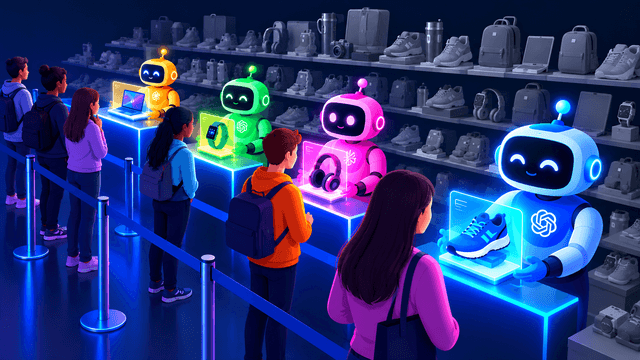
The search engine used to be a doorway to your store. Now, the AI is the destination.
Hold up a minute: If you're thinking, "Whatever, we survive on paid ads anyway," stop right there. The exact same data infrastructure tearing down your organic traffic is also redefining ad relevance. If your backend is garbage, your ad spend is about to vaporize. Read our deep dive on why AI infrastructure dictates 2026 Google ad relevance: Feeding the Bots: Why Product Data Infrastructure Controls the 2026 Google Ad Auction, then come back here.
Traditional SEO—keyword stuffing your collection pages and praying for domain authority—is no longer the ceiling. It’s a basement that just flooded. The new metric isn't organic ranking. It’s AI Citation Share of Voice.
Large Language Models look for consensus. When a buyer asks ChatGPT or Gemini for the best option in your category, they don't get page two. They get three names. You are either inside that synthesized answer, or you are invisible.
The Hard Data: How AI Is Hijacking the Purchase Decision
If you think this is a "future trend" to look at next quarter, look at what’s already happening on the ground:
Massive Traffic Shift: AI-referred traffic to U.S. retail sites skyrocketed by 805% year-over-year on Black Friday 2025, signaling a rapid re-allocation of consumer product discovery. (Adobe Analytics Data)
Higher Conversion Power: Shoppers arriving at e-commerce stores via ChatGPT convert at a rate of 2.47%—significantly outperforming traditional channels like paid search (1.82%) and social media ads (0.52%). (Shopify Data)
The Rise of Zero-Click Retail: In early 2026, a record-high 68.01% of all Google searches concluded directly on the results page without a click, primarily driven by AI Overviews answering consumer queries instantly. (SparkToro Data)
The Click Collapse: When an AI summary or Overview is present during a search, the likelihood of a user clicking a traditional organic search link falls from 15% down to just 8%—a 47% relative drop in traffic. (Pew Research Center Data)
Accelerated Purchase Intent: Users shopping via Microsoft Copilot are 53% more likely to finalize a purchase within 30 minutes, and 194% more likely to convert when clear buying intent is present. (Microsoft Data)
The Rise of the "Ghost Store"
This data points to a brutal reality: we are entering the era of the ghost store.
A ghost store isn’t a broken website. These are brand storefronts that look beautiful to human eyes but are completely invisible to machines. They have great product photos, sleek fonts, and matching color palettes. But beneath the surface, they are data deserts. Because they lack the semantic infrastructure that LLMs require, AI shopping agents and engines like Gemini and ChatGPT pass right over them.
The lights are on, but nobody is home—and the AI doesn't even know you exist.
To survive the zero-click era, your store’s backend needs to stop talking to humans and start talking to machines. Here are five non-negotiable factors for 2026:
1. Semantic Architecture over Keywords
AI agents don't care about your exact-match keywords; they care about context and intent mapping. Your site must be wrapped in hyper-specific, advanced semantic HTML and deeply enriched JSON-LD schema. If a user tells their voice assistant, "Find me a heavy-duty espresso machine that fits under a low cabinet," your site's backend data must explicitly feed those physical dimensions and structural attributes to the crawler in a clean, mathematical format.
2. Real-Time Feed Compliance at Retail Speed
The Shopping Graph updates billions of times an hour. If your product feed says a product is in stock for $49, but a cached script on your actual site shows $54 at checkout, AI engines flag that discrepancy and drop your citation score instantly. In 2026, data precision equals visibility.
3. Machine-to-Machine Checkout Protocols (UCP & ACP)
We are in the era of automated, agentic checkout. Whether it's Google’s Universal Commerce Protocol (UCP) and its Universal Cart, or OpenAI and Stripe’s Agentic Commerce Protocol (ACP), AI agents are now authorized to complete transactions via secure tokens on a user's behalf. If your store's checkout stack isn't built to let an external AI safely authenticate, apply loyalty points, and execute a guest payment via API, you are turning away automated buyers.
4. Structured Media & Alt Tags for Visual Engines
Think alt tags are just for basic accessibility compliance? Not anymore. Context-rich image metadata is what feeds visual search engines like Google Lens, the Gemini app, and free product grids. If your alt tag says image_234.jpg or just black dress, you've already lost.
Google’s visual models need to index your image as the actual physical product entity itself, not just a picture on a website.
Example: BrandX - Mid-Length A-Line - Women's Silk Wrap Dress - SKU: DR-BLK-042 - GTIN: 00812345678901
Hardcoding your unique identifiers, dimensions, and taxonomy directly into the image’s metadata layer transforms a generic file into a verifiable merchant token. The AI needs this explicit loop to trust that the item in the photo is the exact inventory unit ready for purchase.
5. Semantically Linked Graph Networks (The Identity Map)
This is the ultimate separator. AI engines don't just scrape your site; they cross-reference your raw data across the entire web to build an entity graph—a digital identity map—for your products. If the AI detects conflicting data, it won't risk citing your store. Winning brands ensure that their internal data assets—including product feeds, JSON-LD schema (including critical sameAs entity mappings), media alt tags, site FAQs, and even YouTube product video titles and descriptions—align seamlessly to present a flawless, unbroken identity map for every single SKU. While external signals like organic Reddit threads and third-party customer reviews still matter for overall category consensus, locking down this core multi-platform foundation is non-negotiable. To eliminate the guesswork, Shoptiger automates this exact process by deploying an always-on validation engine that cross-checks all of these owned data touchpoints to force AI engines to recognize and trust your products.
Stop Chasing a Rebound
The pendulum will not swing back. The internet is being re-engineered for autonomous agents.
We saw this structural shift coming, which is why we built Shoptiger: the first “always-on” AI Commerce platform designed to handle this exact technical workload. Through our AI Commerce Engine™, we deliver the precise, trusted infrastructure that AI Agents require by automating your entire semantic architecture, feed compliance, and machine-to-machine checkout protocols natively.
And let’s be honest, implementing the concepts and managing a store with more than 5 products in the way I just described isn’t how any Brand or Store should be burning their daylight hours. The technical knowledge required is the stuff only savant developers truly understand - in fact - I haven’t touched on ANYTHING technical in this post. But you don’t need to learn any of that. We’ve done it all for you and automated the entire process.
Book a demo with the Shoptiger team today and let's make sure your store is built for the actual year we live in.