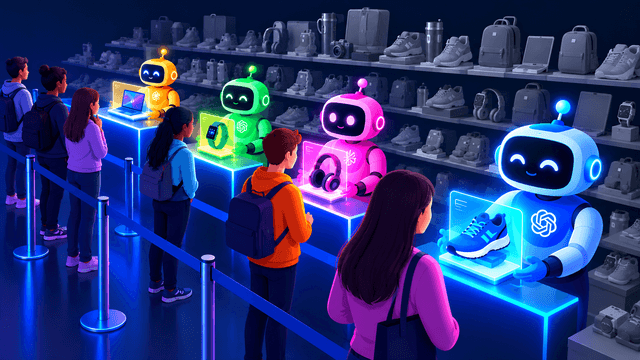

The ecommerce landscape is currently undergoing its most violent shift since the invention of the internet: the transition from "Search" to "Answer." As of April 2026, this is no longer a theoretical evolution; it is a statistical reality. Nearly 40% of consumers now use AI agents to assist with shopping queries, and referral traffic from AI platforms to retail sites has surged by 393% year-over-year.
We are witnessing the collapse of the traditional browsing model. In its place is agentic commerce—where AI like Gemini and ChatGPT act as personal concierges that evaluate, verify, and execute transactions. For e-commerce stores, the math is binary: if your product data is not mathematically optimized to be cited as a "verified fact" by AI Agents, you cease to exist in the decision-making loop. You are either the definitive answer the AI provides, or you are invisible.
The New Rules of Discovery
Traditional SEO focused on keywords and backlinks. AI commerce demands something fundamentally different: semantic authority. Your products must be understood not just as text on a page, but as structured knowledge that AI systems can confidently recommend. The shift is profound—where Google once rewarded pages that contained the right words, AI systems reward entities that carry the right meaning.
This transformation is already underway. Brands that invested early in structured product data are seeing their products surface in AI-generated shopping responses at rates that dwarf their organic search performance. The compounding effect is significant: the more an AI system recommends your products, the more purchase data it accumulates, and the more confidently it recommends you in the future.
What Semantic Authority Actually Means
Semantic authority is not a single metric—it is the aggregate of how well AI systems understand your products, trust your brand, and can act on your data. It encompasses the richness of your product schemas, the consistency of your information across the web, the quality and volume of your verified reviews, and the real-time accuracy of your inventory and pricing feeds.
Brands that have built semantic authority are not just winning more AI recommendations. They are winning better ones—appearing in responses where purchase intent is highest, where the buyer is closest to a decision, and where the AI's confidence in the recommendation is strong enough to drive immediate action.
What This Means for Your Business
The stores that adapt will capture an outsized share of AI-driven commerce. Those that don't will find themselves increasingly invisible to the growing segment of consumers who rely on AI assistants for purchase decisions. This is not a gradual fade—it is a cliff edge. Once a consumer delegates their shopping to an AI agent, they rarely return to manual browsing for that category.
The window to establish AI authority is now. Early movers are building the semantic foundations that will compound over time, making it increasingly difficult for latecomers to compete. The question is not whether your business will be affected by this shift. The question is whether you will be the answer AI gives, or the brand it never mentions.
The Four Pillars of AI Commerce Readiness
Every brand that wants to compete in the AI era needs to address four foundational areas. These are not optional enhancements—they are the minimum requirements for AI visibility:
- Rich product schemas that go beyond basic attributes to include use cases, specifications, and comparison data
- Semantic relationships between products, categories, and the problems they solve
- Trust signals that AI systems can independently verify and cite with confidence
- Real-time inventory and pricing that agents can act upon without risk of recommending unavailable or mispriced items