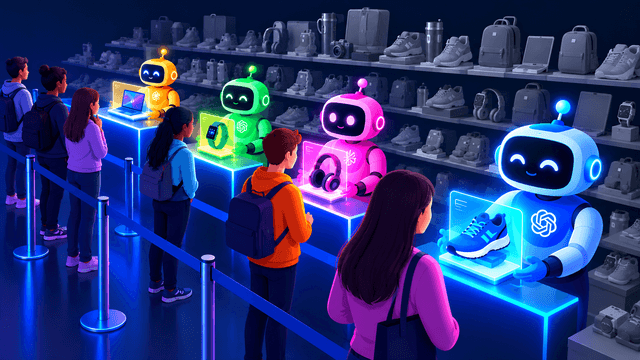

AI-driven referral traffic to U.S. retail sites has seen unprecedented triple-digit surges. We are currently experiencing what industry analysts call "Journey Collapse"—a behavioral shift where a massive chunk of consumers rely entirely on an AI assistant to handle product research, filtering, and discovery before they ever visit a traditional web page.
Because of this, conventional brand loyalty is being replaced by a cold, machine-driven metric: technical confidence. An AI shopping agent does not care about your beautifully designed hero images or brand story. It only cares if its algorithm can programmatically verify your exact product specifications before it risks recommending you as an organic citation or a shoppable product card to a human user.
Many Shopify store owners are sleeping soundly right now, assuming they are fully optimized. They just logged into their admin dashboards, noticed the new "AI Storefronts" section under settings, and enthusiastically toggled the checkbox to "On." Some have gone a step further and sprinkled some Shopify Magic generative text onto their listings, and suddenly they think they are absolute AI wizards. They genuinely assume their products will now soar effortlessly into the AI platforms like superheroes, saving weary shopping agents from the tedium of querying product data.
But here is the reality: out-of-the-box Shopify's Agentic Storefront is just feeding all the AI networks raw, unoptimized data (let's just call it default "garbage"). So, while you're expecting a massive wave of organic AI recommendations from checking a box, they are quietly turning your storefront into an invisible "ghost store."
Before you spend an hour hunting for that shiny new toggle, keep this in mind: Shopify is rolling out the "Agentic Storefronts" framework in waves. Per official Shopify Documentation, if you don't see it in your Sales Channels, you are locked out until the rolling deployment hits your account. And no, opening a support ticket won't save you—help desk support cannot manually override the queue. But you don't have to sit around waiting for a platform invitation. Shoptiger completely bypasses the rollout gatekeeper. We'll talk about Shoptiger in a minute but now let's get back to the article…
To be clear, Shopify’s underlying pipes aren't broken. The network architecture natively pushes your catalog directly to platforms like ChatGPT, Microsoft Copilot, and Google Gemini. For developers building in this space, OpenAI's Documentation on Custom GPTs Actions shows exactly how structured schemas are parsed by modern LLM systems during live database queries.
The problem is that Shopify can only distribute the data you give it.
The AI Verification Gap: The Depth Failure Point
AI shopping bots are fundamentally risk-averse. To avoid "hallucinating" or presenting incorrect information to a user, they rely on a strict dual-verification system before they grant a premium organic citation or display a shoppable product card.
First, they query the Semantic Layer—the baseline product descriptions and titles managed by the core Shopify Catalog API and written by Shopify Magic. Then, they instantly cross-check that data against a Structured Layer—the highly technical data feed living inside your Google Merchant Center (GMC).
This is precisely where the standard setup fractures. If you are relying on Shopify’s native Google & YouTube app alongside default theme schemas, you are passing a very shallow data layer. The native app processes flat files in slow, daily batches, leaving a massive depth gap between the surface-level marketing text Shopify Magic writes and the deeply structured, multi-variant specifications an AI engine needs to verify a specific user query.
As outlined in Google's Merchant Center Product Specifications, missing structural data properties will disqualify item payloads from surfacing correctly. The exact microsecond an AI bot tries to verify a highly specific product claim and hits a wall of unmapped, generic data attributes, its technical confidence drops. It doesn't mean your store breaks; it just means the AI gently passes you over and hands the premium recommendation to a competitor whose data layer is actually built to be cross-verified.
Where the Default Shopify Infrastructure Breaks Down
When data synchronization relies on a passive, surface-level pipe, the lack of granular data depth directly penalizes your visibility for high-intent organic AI citations.
| Breakdown Type | The Native Shopify Framework | The "Invisible Store" Result |
|---|---|---|
| Attribute Fragmentation | The Native Shopify Framework: A shopper queries a "hypoallergenic bamboo sheet set." Shopify Magic writes an excellent product description for humans, but the default Google app fails to map the strict material attribute into the structured GMC payload. The "Ghost Store" Result: The AI agent cannot verify the semantic claim against the structured feed. It flags the data as unverified and refuses to cite your brand for that specific query. | The AI agent cannot verify the semantic claim against the structured feed. It flags the data as unverified and refuses to cite your brand for that specific query. |
| Update Latency | You adjust a product price or stock status during a flash sale. The Shopify Catalog API pushes it instantly to ChatGPT, but your native GMC app is waiting on its 24-hour scheduled fetch. | The AI detects a temporary data conflict between the live endpoint and the daily feed file. To prevent a pricing error, it lowers your recommendation priority until the sync catches up. |
| On-Page Schema Blindspot | Your Shopify theme auto-generates basic microdata filters, but it leaves out critical cross-entity graph maps like embedded FAQ codes, brand Organization data, or individual review entities. | AI models crawl your live page to verify the entity's authority. Following the validation rules on Schema.org's Product Graph, they pass over your link if they hit a fragmented text file instead of a complete structural graph. |
| Visual-Textual Mismatch | Google Lens or Gemini identifies a "striped" pattern from your main product image. Shopify's default taxonomy completely leaves out the mandatory pattern attribute mapping in the backend feed. | The system cannot structurally reconcile what the visual model "sees" with what the text feed states. You lose placement on the free visual search grid. |
The Moment of Truth: What Happens Next?
Eventually, reality sets in. You log back into your admin to look at your fresh new AI Storefronts reporting panel, fully expecting to see a hockey-stick surge of enthusiastic new buyers buying from your store via ChatGPT, Copilot or Google AI Mode.
Instead, the reporting doesn't show the expected surge. The baseline traffic is trickling in, but you aren't capturing the high-intent, premium recommendations that move the needle.
Most Shopify store owners are out of tricks at this point. You can't ask Shopify Magic to sprinkle your products in irresistible AI-intoxicating pixie dust. If the foundational, machine-readable data infrastructure isn't deeply enriched across both your backend endpoints and your live on-page code, you are stuck. Shopify will keep syndicating your data perfectly, but the AI engines will continue to treat your shallow data layer like a ghost.
Enter Shoptiger
Shoptiger doesn't replace Shopify's native AI channels; we ensure the data flowing through them actually has the depth required to win the recommendation. We completely re-architect your technical data layer so AI engines can seamlessly verify your products in milliseconds.
- Real-Time Graph Generation (On-Page): Instead of relying on basic theme files, Shoptiger injects a comprehensive, real-time structured schema graph directly onto your product pages the exact second your catalog updates. It bundles your product variants, organization data, authors, rich FAQs, and deep review metrics into a highly machine-readable index that AI crawlers demand for free organic citations.
- Deep Context Feed Enrichment: We intercept your product stream, fully enrich it with granular variant specifications, and distribute an identical, high-fidelity data asset to Google Merchant Center while simultaneously feeding optimized endpoints for ChatGPT and Microsoft Copilot. Your data matches across every environment perfectly, building immediate technical confidence.
- The Semantic Sync Safety Net: Standard feed apps are completely passive; if a data misalignment occurs, it sits silently in a dashboard until you notice it. Shoptiger’s Semantic Sync acts as an active validation layer. It constantly cross-checks your on-page schema, your external AI endpoints, and your GMC feeds—flagging discrepancies, diagnosing the technical error, and auto-correcting it before an AI crawler ever has the chance to de-prioritize your store.
You can keep crossing your fingers and hoping Shopify's default checkbox will be deep enough to earn you those valuable free AI recommendations, or you can actually build the infrastructure required to survive the modern AI auction. Shoptiger implements the precise data integrity required to ensure your inventory qualifies to be cited by the networks dominating modern commerce.
Pro-tip: Don't learn this stuff. Shoptiger does it all for you. Book a demo today.