If you have a store, you have a Google Shopping Feed, and someone in your sphere is responsible for it — your ads agency, in-house IT, feed app or service, whatever. It gets submitted to Google Merchant Center, errors are cleared, and somewhere along the line, someone even said they optimized it for you. And the proof is — your PMax ads are running and no one is talking about it anymore so you cross it off your list.
Most retailers do a lousy job of optimizing their product feeds, including some of the biggest and most successful ecommerce brands. Their feeds are missing valuable product specifications, descriptions are thin, and important attributes are either incomplete or entirely absent. And don't assume for one second that Shopify is handling this for you (read this post if you want to know what Shopify actually does and doesn't do). The vast majority of stores sort of unwittingly feeding Google the bare minimum required to get a product approved and completely miss a massive opportunity to capture more AI sales.
I don't expect you to understand why I just made that connection.
You don't have time to time to investigate how Google Merchant Center (GMC) influences ChatGPT recommendations, figure out which product attributes matter to AI, or keep up with Google's latest changes. People like me do that stuff. We mostly keep it to ourselves because it gives us and our clients a huge competitive edge. But I'm gonna tell you everything — and I've done the homework — because the new AI commerce landscape is moving so fast I'll have 10 other awesome things locked in by the time you figure this out. So here's what you need to know in a three-minute read.
Shoptiger solves AI shopping for you. 1-click install. No in-house dev or IT needed. Book a demo
Your GMC feed is no longer just about Google Shopping. It's a critical part of your AI shopping strategy. And the evidence connecting Google Shopping to AI product recommendations is substantial — even if it isn't in the official documentation.
An analysis of more than 43,000 products appearing in ChatGPT shopping carousels found that over 83% matched products in Google's top 40 organic Shopping results. A separate Semrush experiment found ChatGPT's top recommendation among Google's first three Shopping results in 75% of runs.[1][2]
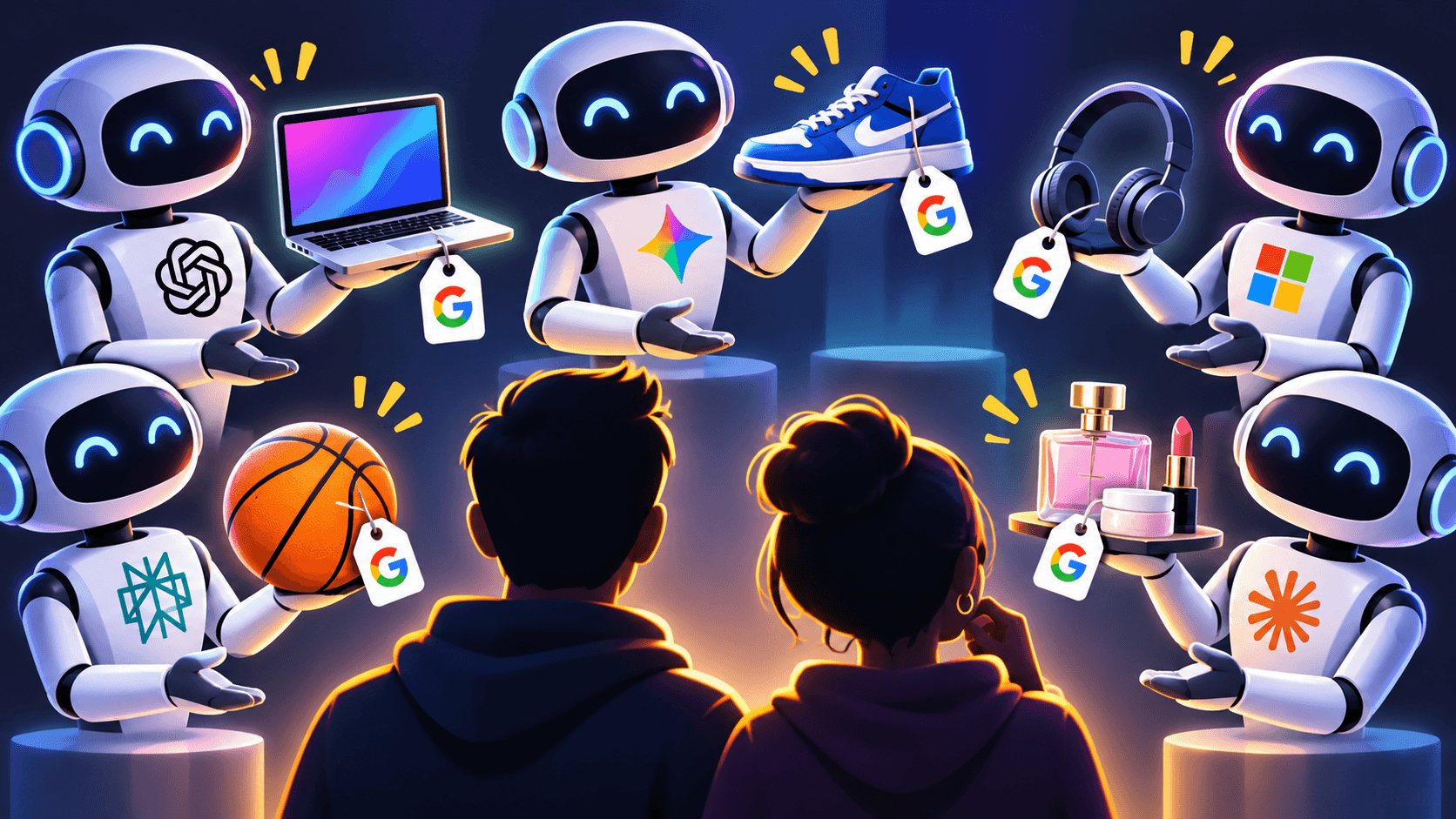
Think about that. Google Merchant Center supplies structured product information to Google's shopping ecosystem, and ChatGPT's product recommendations show extraordinary overlap with Google Shopping. ChatGPT doesn't need direct access to your GMC feed for the information you submit to Google to influence what it recommends.
Here's how GMC connects to the major AI shopping platforms.
| AI platform | GMC connection |
|---|---|
| Google AI Mode | Direct. Uses Google's Shopping Graph, which incorporates GMC data. |
| Google Gemini | Direct. Shopping experiences use Google's Shopping Graph. |
| ChatGPT | Strong indirect connection. Research found 83%+ overlap with Google's top 40 Shopping results. |
| Microsoft Copilot | Microsoft Merchant Center supports importing product offers from GMC. |
| Apple Intelligence / Siri | Apple's Visual Intelligence supports Google-powered product searches. A broader Siri connection isn't established. |
| Perplexity | Uses external shopping and retailer information; a specific GMC connection isn't verified. |
| Claude | Uses external product information; a specific GMC connection isn't verified. |
The ChatGPT findings are particularly significant. Researchers didn't simply compare product names. They also examined shopping-specific queries and reconstructed Google Shopping product URLs associated with ChatGPT recommendations.[1] While the research doesn't establish the exact source of every recommendation, it makes a compelling case that Google Shopping plays an important role.
And Google has already confirmed that richer merchant-supplied attributes contribute to its own AI shopping experiences. In a test involving lululemon, Google reported incorporating conversational product attributes into relevant AI Mode recommendations 50% of the time.[3]
So why are retailers still submitting product feeds that barely describe what they're selling?
Your product feed is missing more than you think
Most Shopify and WooCommerce stores synchronize their catalogs with GMC and move on. Products are approved, prices and inventory update, and everything appears to be working.
But getting products approved isn't the same as optimizing them for discovery.
Google allows product descriptions up to 5,000 characters, yet many retailers submit a couple of generic sentences. Google also supports structured product specifications through product_detail and important selling points through product_highlight, both of which Google identifies as useful for AI-driven shopping experiences.[4]
Consider a Nike SB Dunk Low skate shoe. A typical feed might describe it as a low-top skate shoe with suede overlays, a padded collar, and a rubber outsole. That's enough to identify the product, but it leaves out information about cushioning technology, heel impact protection, midsole construction, outsole traction, and other features that shoppers might specifically request.
An enriched record could identify verified characteristics such as Air Zoom cushioning, a Zoom Air heel unit, a foam midsole, a pivot-circle outsole pattern, padded tongue construction, and perforated toe-box detailing. These are illustrative specifications for a model with those verified features, not universal claims about every SB Dunk Low.
Now imagine someone asking ChatGPT for a low-top skate shoe with suede overlays, heel impact protection, and a pivot-circle traction pattern. The enriched feed provides a much better description of the product's suitability than the basic one.
That's the gap. Retailers spend fortunes getting shoppers to their products while neglecting the product information AI needs to understand and recommend them.
And the problem extends well beyond footwear. Electronics, automotive parts, apparel, furniture, sporting goods, and practically every other product category contain valuable specifications and characteristics that rarely make it into standard merchant feeds.
Google gives retailers several ways to supply this information. Detailed descriptions explain the product in natural language. product_detail organizes specifications into named sections and attributes. product_highlight identifies distinguishing features. These fields complement one another, and there's no good reason to ignore them when accurate information is available.
Google just made feed enrichment even more important
Google has introduced six optional conversational attributes designed to provide richer information to AI shopping experiences.[5] These address the kinds of questions customers ask when shopping through AI assistants rather than typing a few keywords into a search box.
| GMC attribute | What it does |
|---|---|
| question_and_answer | Provides answers to product-specific questions about features, compatibility, and usage. |
| document_link | Connects products to manuals, technical specifications, and installation guides. |
| related_product | Identifies accessories, complementary products, substitutes, and required parts. |
| item_group_title | Defines the shared name of a product family. |
| variant_option | Describes differences between variants, including size, color, memory, and other options. |
| popularity_rank | Tells Google how popular a product is relative to other products in the retailer's catalog. |
That last attribute deserves attention. popularity_rank allows retailers to assign products a numerical popularity score from 0 to 100, ideally calculated from recent sales data within comparable product categories.[6]
A bestselling running shoe might receive a score of 97.5, while a slower-selling model gets 35.0. These aren't industry-wide rankings; they're based on the retailer's own sales performance. When a shopper asks an AI assistant for the most popular shoes, bestselling products, or customer favorites, that ranking gives Google an explicit merchant-supplied signal rather than leaving popularity entirely to inference.
The other attributes are equally practical. A customer asks whether an accessory fits a particular device, which replacement part is required, or what distinguishes two product variants. Retailers can now provide structured answers and relationships directly through Merchant Center.
Google says these conversational attributes are intended to support AI shopping experiences, including AI Mode. They can be supplied through supported feed methods, including supplemental data sources and the Merchant API, without necessarily replacing an existing catalog integration.[5]
There's also an important relationship between GMC enrichment and product-page schema. The feed supplies structured product information directly to Google's merchant infrastructure, while Schema.org markup makes product information machine-readable on the website. Product variants, related items, documentation, and other characteristics can be represented in both systems using their respective formats.
Your feed and product-page schema should work in concert, drawing from the same accurate product information. They don't need identical fields, and not every GMC attribute has a direct Schema.org equivalent. But they shouldn't contradict each other. Schema reinforces the feed; it doesn't replace it.
And none of this means abandoning the fundamentals. Accurate GTINs, MPNs, brands, categories, variant relationships, pricing, availability, and product imagery remain essential. Enrichment builds on those foundations by supplying the details that distinguish products and help shopping systems evaluate specific customer requirements.
Stop treating GMC like a catalog export
If I were auditing an ecommerce store today, I'd start by comparing its existing GMC feed against the actual information available about its products. Not just the product pages, but manufacturer specifications, technical documentation, compatibility data, and other verified sources.
I'd look for missing specifications, incomplete descriptions, unused product details and highlights, and opportunities to populate Google's conversational attributes. I'd also make sure the product-page schema reinforces the same information.
Then I'd test relevant shopping prompts across Google AI Mode, ChatGPT, Copilot, and other assistants to see how the products appear and which characteristics influence the recommendations. I'd also search Google's Shopping Tab and when my products surface, toggle the checkbox filters on the left to see which ones vaporize my products.
There's an important distinction in the research: the studies demonstrate a strong relationship between Google Shopping results and ChatGPT recommendations, but they don't quantify the precise lift from adding individual feed attributes. That requires controlled testing. It doesn't change the case for enrichment, particularly when Google explicitly identifies richer product information as useful for AI shopping discovery.
For years, retailers have viewed GMC primarily as the infrastructure behind Google Shopping ads and free listings. That thinking is outdated. Google's product data now participates in a much broader shopping ecosystem, and independent research shows just how closely other AI shopping experiences can align with Google's results.
The good news for you is: Most retailers haven't caught up. They're still sending thin product records into increasingly sophisticated shopping systems and wondering why their products aren't being discovered. That's not you. You're going to take action right now and put those dinosaurs out to pasture.
Your GMC feed isn't just for Google anymore. It's one of the most important product-data assets in your AI shopping strategy. Start treating it that way.
Now that we're at the end, I'm going to offer you a solution that takes all the work right off your plate and automats everything: Shoptiger. It's a complete AI commerce solution that handles your Google product feed and hundreds of other complex AI optimizations so you can win recommendations and sales from ChatGPT, Gemini, Siri, Google AI Mode, Perplexity, Copilot and others. Book a demo with us — it's free, no pressure, and you'll learn a lot. Then decide if you just want to take what we tell you and do it yourself. Of course you can't and even trying would be insane! Book a demo here and I'll explain. Or, go to the homepage and click Watch Video to learn how Shoptiger AI Commerce Engine™ works.
Sources
[1] Search Engine Land, March 2026. ChatGPT Shopping Carousel Analysis.
[2] Semrush, January 2026. ChatGPT Searches Google Shopping to Create Its Recommendations.
[3] Google, 2026. Google Shopping Updates and Agentic Commerce.
[4] Google Merchant Center. Product Data Specification, Product Detail, Product Highlight.
[5] Google Merchant Center. How to Use Conversational Attributes.
[6] Google Merchant Center. Popularity Rank